Summary
Enterprise AI deployment is moving to the center of the conversation, and companies that deploy well may be able to turn it into a meaningful advantage. At Grove Ventures’ AI, Deployed meetup, more than 150 people heard leaders from Palantir Technologies, Wonderful, and Kela Technologies discuss the role of the Forward Deployed Engineer (FDE) and how to deploy Enterprise AI at scale. The panel surfaced three practical lessons: look at where your deployment team spent its time last week, do not let deployment work stay with a single customer, and measure whether each deployment gets cheaper.
AI does not become enterprise infrastructure on its own. Successful deployment requires teams that work closely with customers, turn complex needs into working solutions, and find a path from one implementation to many.
At Grove Ventures’ AI, Deployed meetup, we brought together more than 150 people to tackle some of the most pressing questions around Enterprise AI deployment, reinforcing something we are seeing across the market: deployment is moving to the center of the conversation.
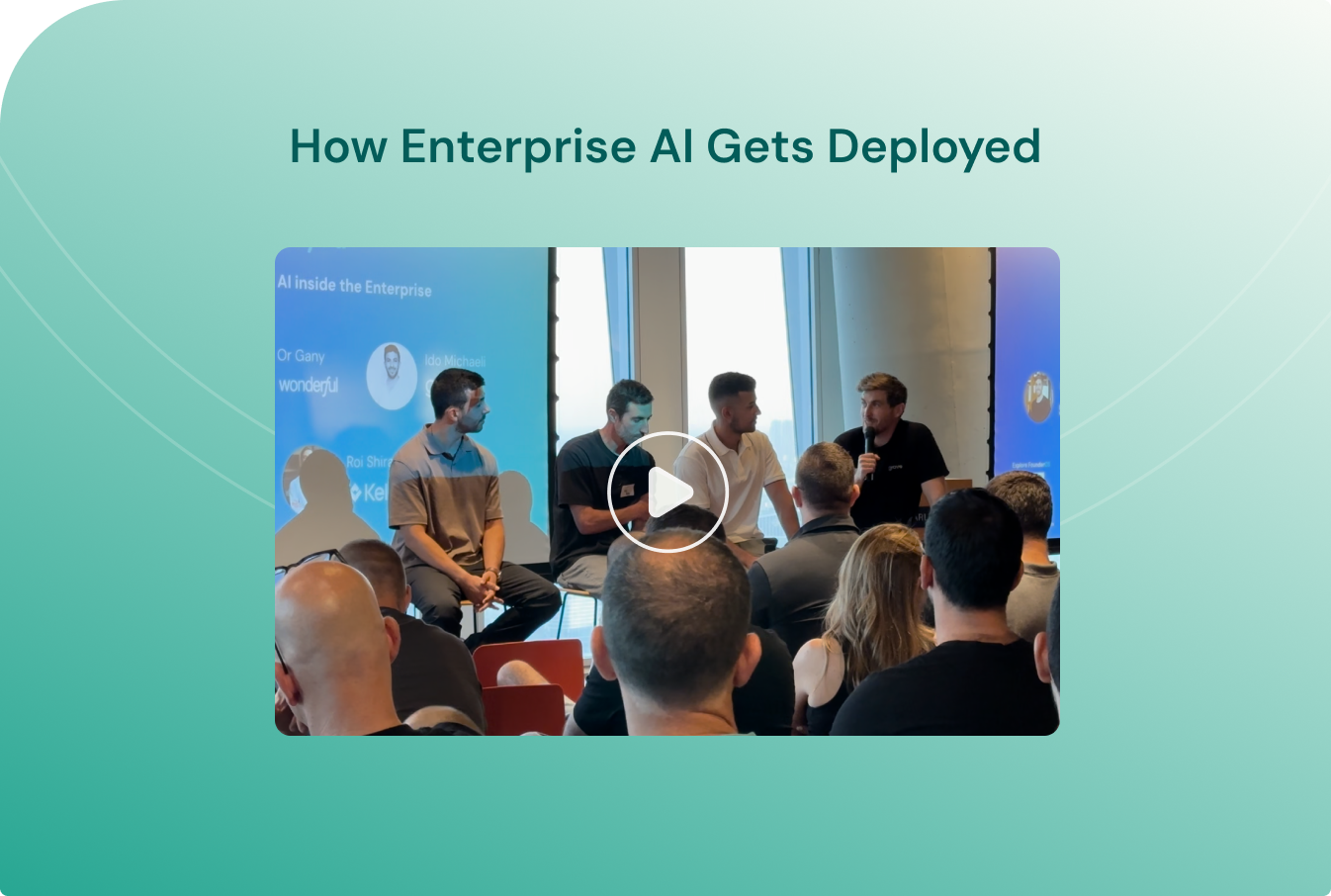
The panel featured Ido Michaeli, FDE Enterprise Lead at Palantir Technologies; Or Gany, CTO Israel at Wonderful; and Roi Shiran, Head of Platform at Kela Technologies. It was moderated by Lotan Levkowitz, Managing Partner at Grove Ventures. The panelists shared lessons learned from deploying Enterprise AI at scale.
Watch the panel highlights below:
The discussion started with a question that still produces strong reactions across the industry: what exactly is a Forward Deployed Engineer, and how is the role different from that of a traditional engineer?
The difference starts with the skill set. An FDE needs engineering capabilities, but the role also requires working directly with customers, taking responsibility for what happens during deployment, understanding what is happening in the field, and connecting those signals back to the company.
At Palantir Technologies, FDEs manage and take responsibility for their domain. They have significant freedom around deployment and what happens in the field. When something goes wrong, they are responsible for solving it. That autonomy is supported by structured communication with Palantir’s central hub and clear boundaries between roles.
Three practical lessons stood out from our discussions around AI deployment.
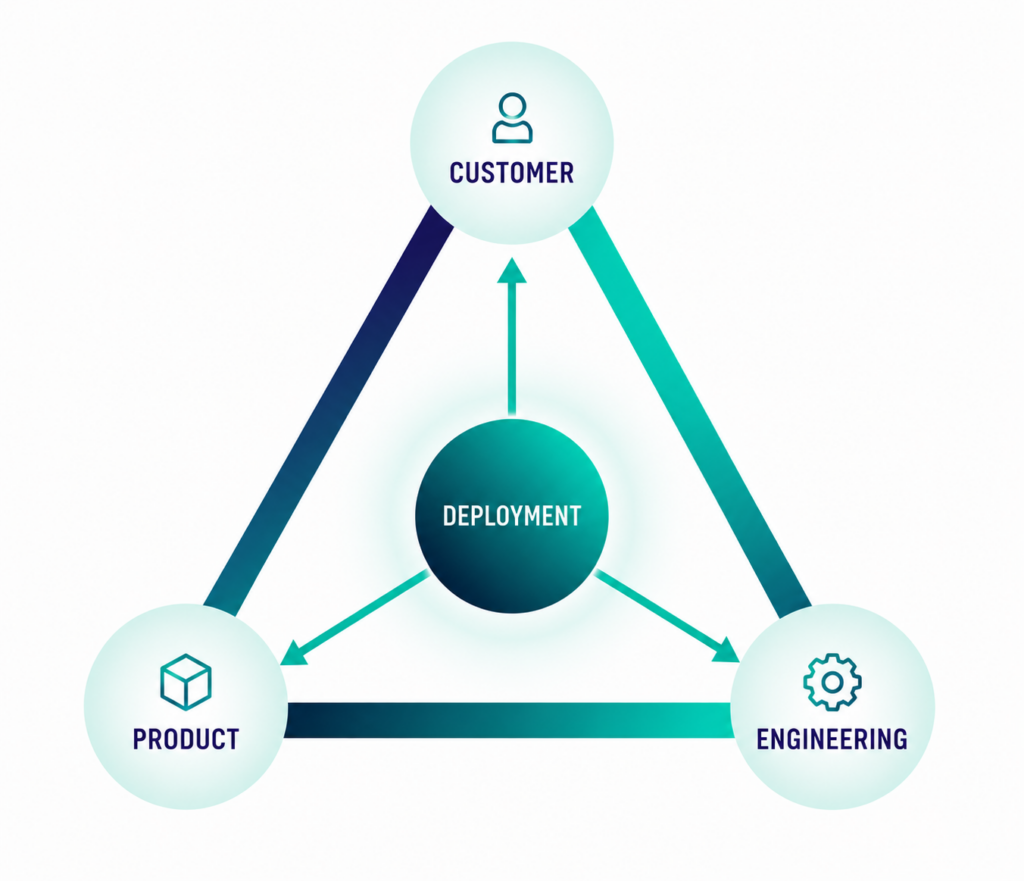
Deployment teams sit between product, engineering, and customer success, and wherever ownership is unclear, they tend to step in and fill the gap.
If product leadership is not setting the roadmap, deployment engineers may end up shaping it from the field. If no one clearly owns the customer relationship, that can fall to them too.
Where the team spends its time is therefore a useful diagnostic. It quickly reveals unclear ownership, missing capabilities, and where clearer boundaries are needed.
Deployment teams need to stay close to customers without turning every request into custom work or immediately adding it to the core product.
The key is repetition. If the same request appears across five or six customers, it may belong in the product. If it is truly a one-off, it can remain specific to that deployment.
At Wonderful, FDEs bring recurring patterns from the field back to the company, while the product team decides what should become part of the product and what should remain specific to one deployment. The goal is to turn what is learned in the field into a feedback loop for what the company builds next.
A simple way to test whether deployment is becoming more scalable is to track how many engineer-weeks each implementation requires. A second use case for the same customer should take less time than the first. The same use case for the next customer should take even less.
Every deployment should also have an endpoint. At Kela Technologies, the FDE is part of the product’s value proposition, not the business model. The goal is to help customers become independent as quickly as possible, so they can use the product without ongoing FDE support.
If engineers cannot eventually hand over responsibility and move on, the company risks becoming a services business.
Enterprise AI deployment is still in a period of broad experimentation. There is no single model to follow, especially as the AI landscape itself continues to change rapidly.
For Grove, the takeaway is clear: companies cannot wait for a playbook to emerge. They need to experiment, learn what works for their product and customers, and refine their approach as they go. Those that do this well may be able to turn deployment into a meaningful advantage.
That is why Grove Ventures is continuing to follow this space closely, learn from the people building in it, and work with our portfolio companies as they adapt their approach to deployment.
AI, Deployed will return with AI, Deployed 2.0 in November 2026, alongside our AI Deployment Matchmaking Platform, connecting companies hiring for deployment roles with people building in this space.
For more on Enterprise AI deployment, read “Nobody Buys AI. They Buy AI Deployment.” by Lotan Levkowitz and Litan Cherikover.
FAQs
A: A Forward Deployed Engineer is an engineer who works directly with customers and takes responsibility for what happens during deployment. The role requires strong engineering capabilities, but also the customer-facing skills to work closely with users, understand what is happening in the field, and bring those insights back to the company. At Palantir Technologies, FDEs manage and take responsibility for their domain and have significant freedom around deployment. When something goes wrong, they are responsible for solving it.
A: Unlike a traditional engineer who may work primarily from product requirements or tickets, an FDE works directly with customers and takes responsibility for deployment outcomes in the field. According to the AI, Deployed panel, deployment teams sit between product, engineering, and customer success. Because of that position, they tend to step in wherever ownership is unclear, which can mean shaping the roadmap from the field or taking on the customer relationship.
A: A simple test is to track how many engineer-weeks each implementation requires. A second use case for the same customer should take less time than the first, and the same use case for the next customer should take even less. Every deployment should also have an endpoint. At Kela Technologies, the FDE is part of the product’s value proposition, not the business model, and the goal is to help customers become independent as quickly as possible.
A: No. According to the AI, Deployed panel, Enterprise AI deployment is still in a period of broad experimentation, and there is no single model to follow, especially as the AI landscape continues to change rapidly. Grove Ventures’ view is that companies cannot wait for a playbook to emerge. They need to experiment, learn what works for their product and customers, and refine their approach as they go.
A: AI, Deployed is a meetup hosted by Grove Ventures, an early-stage venture capital firm based in Tel Aviv, focused on Enterprise AI deployment. The first event brought together more than 150 people and featured a panel with Ido Michaeli of Palantir Technologies, Or Gany of Wonderful, and Roi Shiran of Kela Technologies, moderated by Grove Ventures Managing Partner Lotan Levkowitz. AI, Deployed will return with AI, Deployed 2.0 in November 2026, alongside Grove’s AI Deployment Matchmaking Platform.