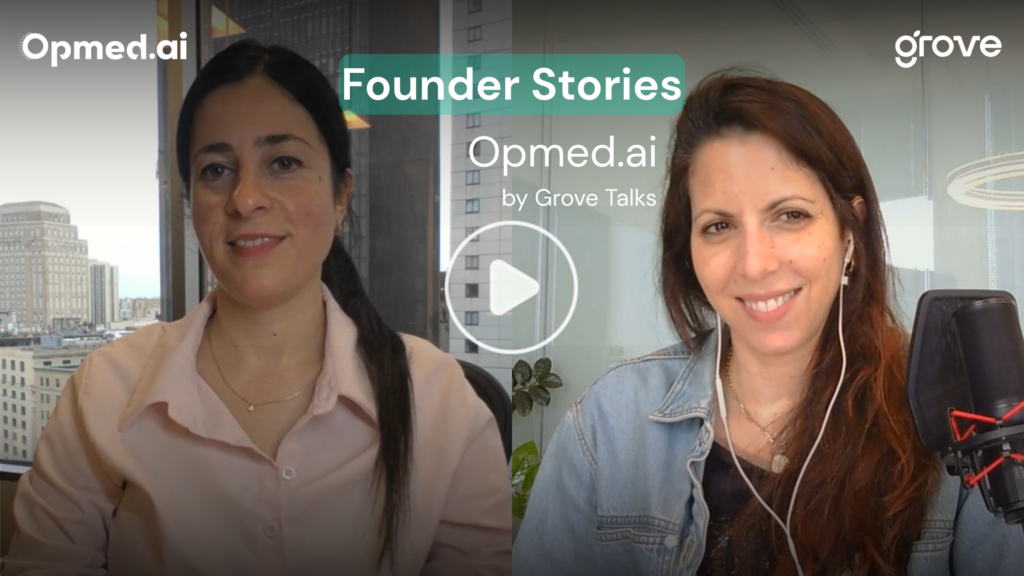
A Grove Talk with Dr. Mor Brokman, Co-Founder & CEO of Opmed.ai, and Renana Ashkenazi.
When Renana Ashkenazi first met Dr. Mor Brokman, Co-Founder & CEO of Opmed.ai, she thought Mor was impressive, but the story sounded unlikely. The projections felt too ambitious. The milestones seemed unrealistic.
The next time they spoke, Mor was already in Boston. Opmed.ai’s platform was running in Israeli hospitals, showing measurable financial results, and entering serious conversations with major U.S. health systems. For Renana, it became one of the clearest times she remembers being proven wrong.
Watch the video here or listen on Spotify.
Opmed.ai began during COVID, when Mor wanted to apply her work on the complexity of work plans to a real, urgent problem. Healthcare pulled her in quickly.
She started speaking with hospital leaders in Israel, then the UK, then the U.S. The first signal was simple: people answered. Then they agreed to another meeting. Then another. The real validation came when hospitals were willing to pay.
Opmed.ai focused first on operating rooms because the pain was sharp and the economic value was clear. Hospital scheduling is not just putting names on a calendar. It is cancellations, emergency surgeries, procedures that run longer or shorter than expected, staff constraints, rooms, waiting lists, and constant change.
Hospitals were trying to optimize one of their most valuable resources with human effort alone, and the gap was obvious.
Before Opmed.ai, Mor had already founded a startup. It did not succeed as a company, but she still describes the experience as successful because of what it taught her.
The biggest lesson was product market fit. In that first company, she said yes to too many customers across too many industries. The product had to fit too many different needs, and there was no strong enough common denominator to fit them all.
After that, Mor went into academia; the PhD was not a detour from entrepreneurship, but a way to specialize, build deeper expertise, and return to company-building with a sharper point of view.
That path eventually led her to healthcare, where the problem was repeated across many hospitals, painful enough to matter, and valuable enough to build around. The product market fit was strong.
Opmed.ai was founded before AI became part of every startup conversation, but that shift actually helps Opmed today, since hospitals used to see adopting AI as a risk. Today, many see it as necessary.
A tool like GPT or Claude may be powerful, but it is not built to solve complex hospital scheduling on its own. The hard part is knowing which constraints matter, modeling them correctly, and solving the optimization problem fast enough to be useful.
That is where the company’s moat comes from: years of learning how hospitals operate, deep integrations, access to real operational data, more than 20 million surgical records, and trust from leading health systems. In software, defensibility can sound abstract. In Opmed.ai’s case, it lives in the details.
Mor moved to Boston three years ago to build the U.S. business, while her co-founders, Avi Paz and Professor Baruch Barzel, continued leading the company’s work in Israel. Looking back, she says Opmed.AI would not have reached the same place without that move.
Her view is direct: the founder needs to be where the customers are. U.S. healthcare sales are slow, complex, and full of stakeholders. Being close to the market made it easier to meet customers, build trust, and reduce friction.
That setup only works with deep co-founder trust. Mor and Avi speak constantly across time zones, without ego and without keeping score. Without that kind of communication, two offices can quickly become two separate companies.
The full episode goes deeper into what Mor learned the hard way: which founder mistakes can be avoided, where the real shortcuts are in U.S. healthcare sales, what Israeli founders often get wrong about the market, how investor relationships evolve, and how to protect the company’s DNA as it scales.
Explore more Founder Stories →