By Lotan Levkowitz

By Lotan Levkowitz
A new framework for categorizing SDLC-focused companies
Earlier this week, we presented Grove Ventures’ Shift Happens Report: The State of Software Development Life Cycle 2023. We learned a lot from our extensive work in the software infrastructure field, as well as in this research. We saw that a lot of founders and investors often view the ecosystem through the lenses of the startups’ value proposition for the software development life cycle (i.e., focusing on a company’s value proposition for observability, testing, security or FinOps, and what new features or technology this company brings to the landscape). The debate on startups’ Go-to-Market strategy, we noticed, is many times delayed to later stages. We believe, however, that SDLC-focused startups should start planning their GTM strategy much earlier.
After many hours of interviews, we reached clarity that enabled us to develop a new framework and categorize SDLC-focused startups into six distinct company archetypes, based on their Go-to-Market strategy. We believe that identifying the appropriate archetype can assist companies in shaping their go-to-market strategies effectively, accelerating their growth, and proactively addressing unique challenges ahead.

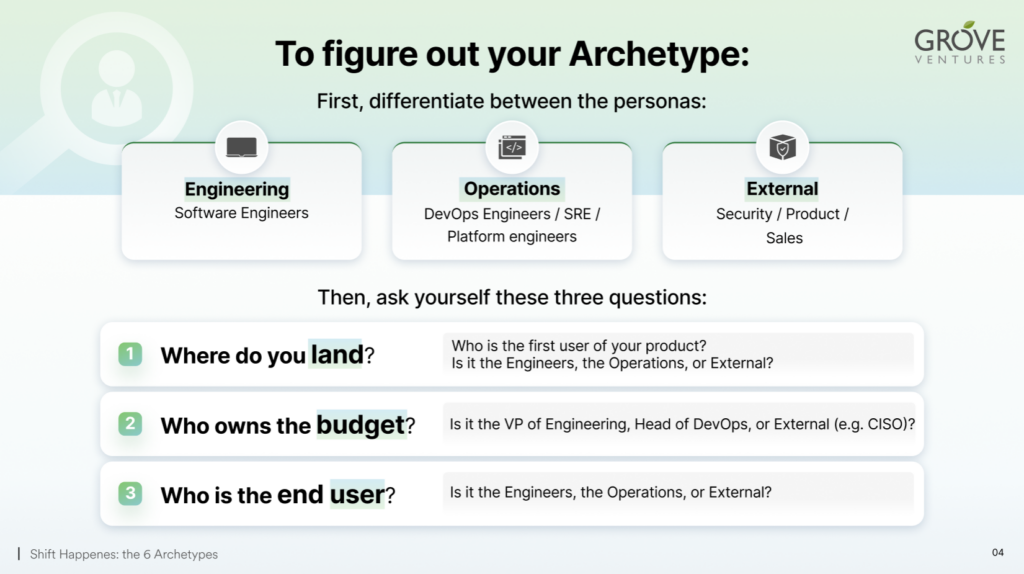
To figure out which archetype matches their companies:
First, founders should differentiate between three buying personas for their offering:
Then, founders should ask themselves three questions:
To get a taste, here are three examples of archetypes out of six mentioned in the full presentation below:
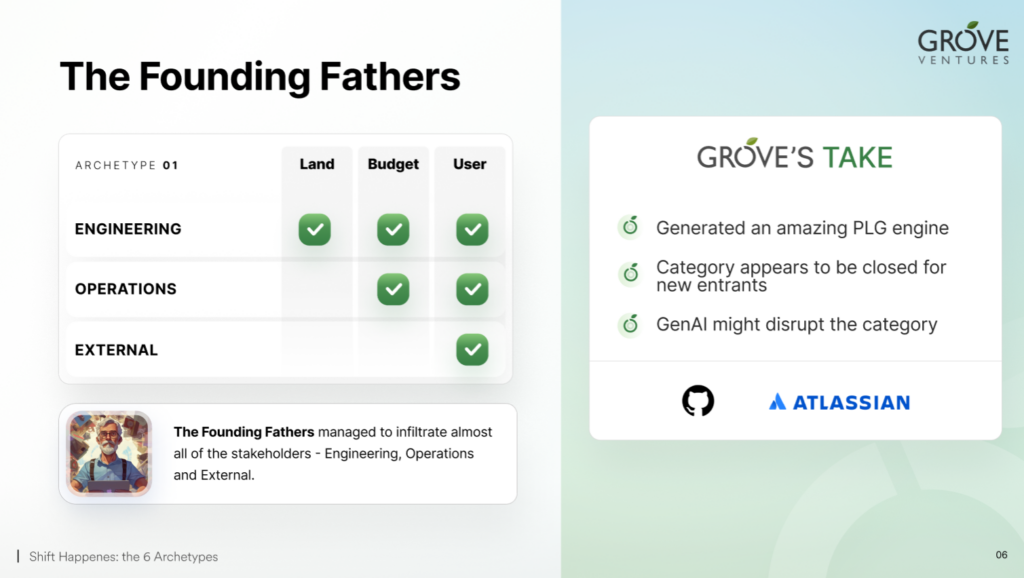
The first archetype is easy to spot from a mile away: ‘The Founding Fathers’. These are the titans of the software development world, the stable stakes in the industry and at any software company. Think of Github or Atlassian.
For companies that match this archetype, we believe GenAI might be key to disrupt the market. Since big companies already embraced code generation tools, now Large Language Models can be used in creative ways building on these companies’ immense amounts of data.
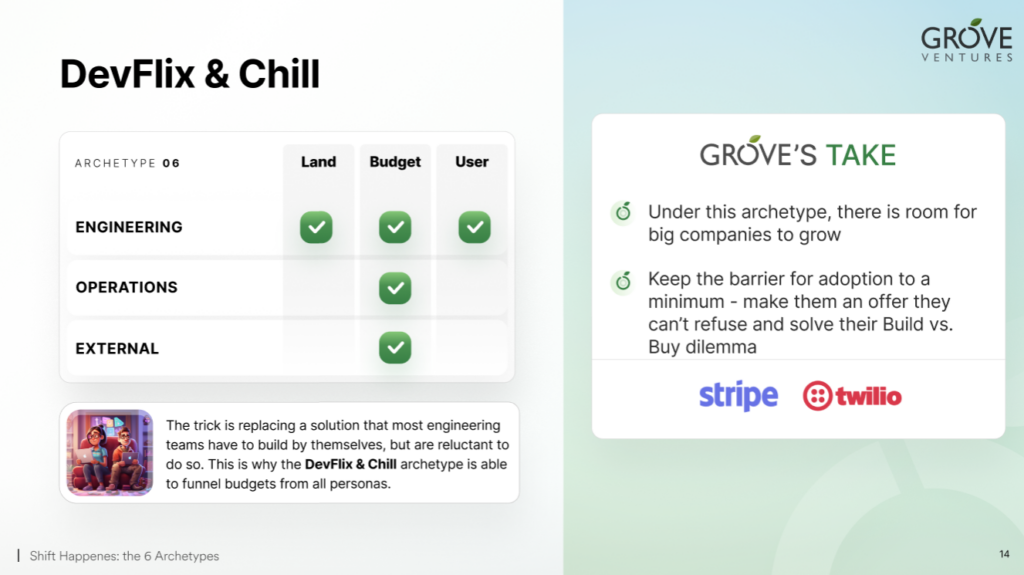
The DevFlix & Chill archetype covers companies that build solutions that many engineering teams might have needed to build on their own, but were reluctant to do so. These companies often answer a need which is external to the engineering organization (e.g., of the Revenue team).
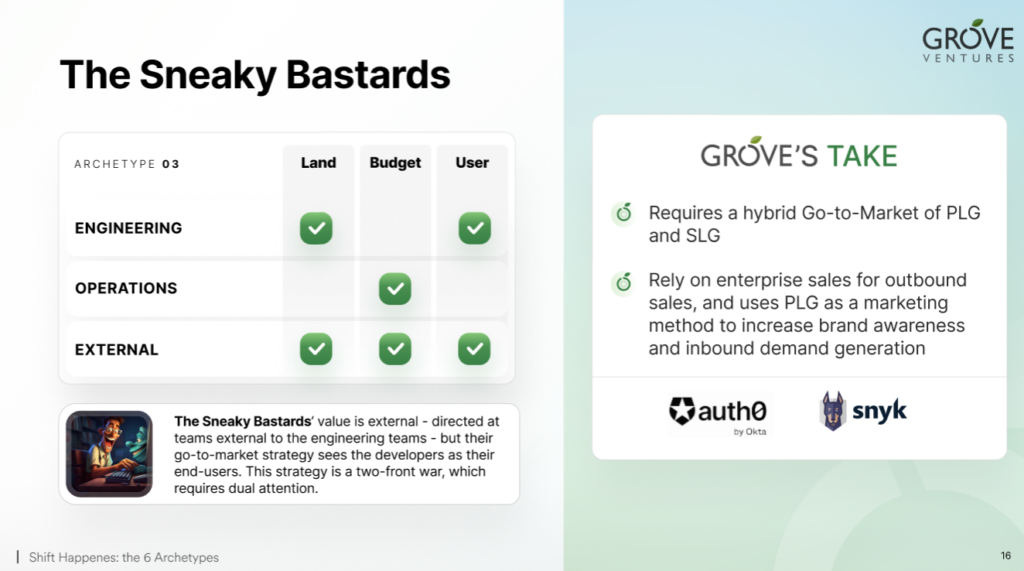
This archetype is a tricky one. The ‘Sneaky Bastards’ use a clever distraction strategy to penetrate the market, which resembles the same ‘Look, a Bird!’ distraction method used by parents to convince a reluctant baby to eat.
When founders build companies, we encourage them to start thinking about their Go-to-Market strategy, even before writing their first line of code. They should identify their company’s archetype and learn from the Go-to-Market experience of their predecessors.
Identifying a company’s archetype can help founders unlock their full potential, visualize their journey to product-market-fit concerning all their stakeholders for all relevant buying personas, and assist with:
The software developer life cycle continues to evolve. The six archetypes presented above are based on market insights we gathered as part of Grove Ventures’ Shift Happens research. We started this ecosystem discussion back in May, and we invite you to challenge our perspectives and share additional thoughts and insights:

Lotan Levkowitz, General Partner – [email protected];

Tal Abuloff, Associate Investor – [email protected]
To join our Shift Happens community, please fill in this form.
Special thanks to Daniel Ben Zvi, Uri Schiner, Ofir Ehrlich, Aner Mazur, Zack Smocha, Amit Attias, Ofer Kirshenbaum, and Ran Ribenzaft for reading drafts and contributing their thoughts.