Explore Founder OS: AI tools to help you build faster
Founder OS Founder OS



By Renana Ashkenazi


By Renana Ashkenazi
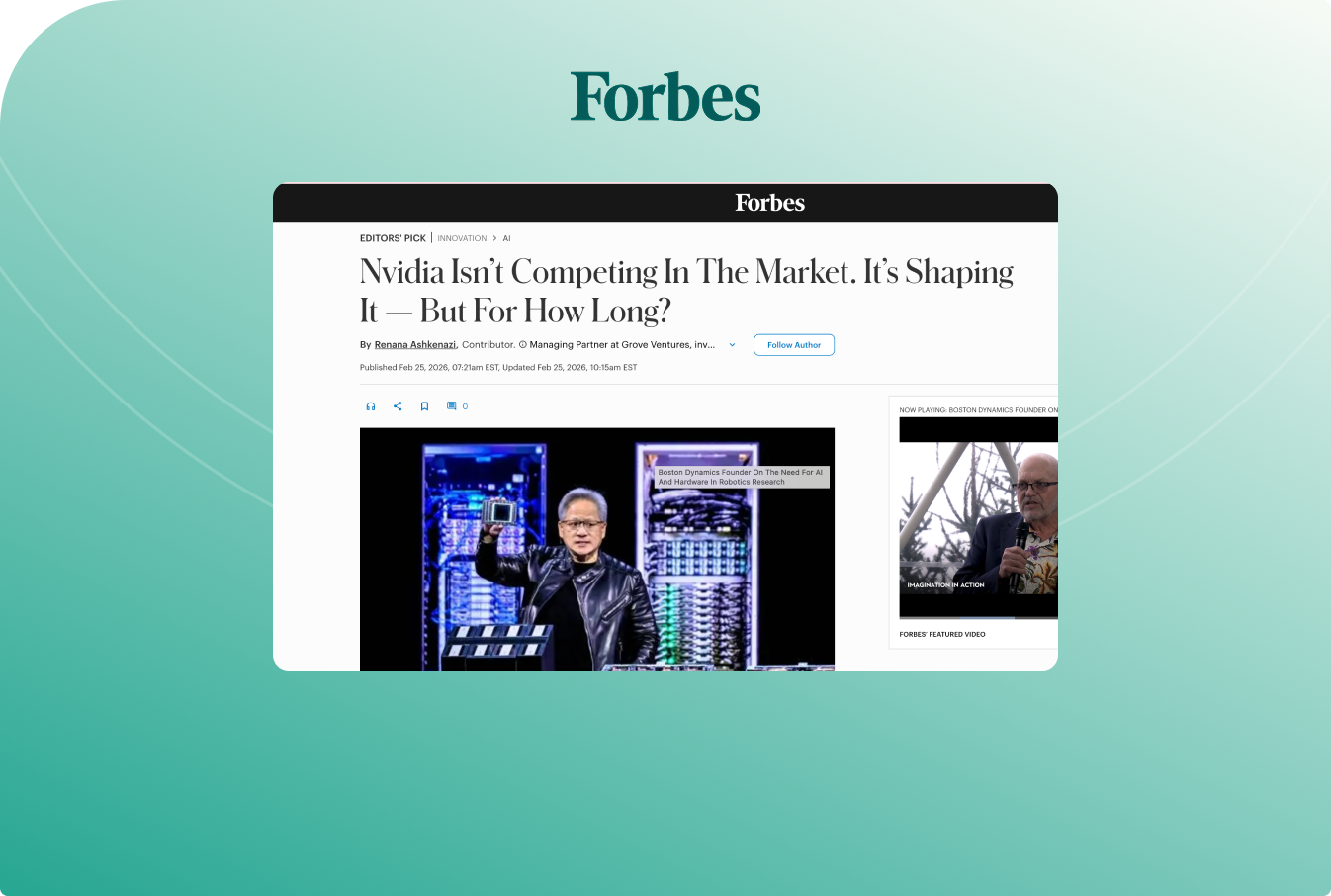
In a recent Forbes feature, Renana Ashkenazi examines OpenAI’s $110 billion funding round, structured not just as a capital raise but as a supply chain deal embedded in infrastructure commitments.

OpenAI announced a $110 billion round at a $730 billion pre-money valuation, with Amazon investing $50 billion, Nvidia $30 billion, and SoftBank $30 billion.
Amazon’s investment is paired with a $100 billion AWS expansion over eight years, making AWS the exclusive third-party cloud provider for OpenAI’s enterprise platform. The deal includes a commitment to 2 gigawatts of Trainium chips. Nvidia’s investment ties directly to data center capacity.
“The money goes in as equity. It comes back as revenue.” The round functions as a closed loop.
OpenAI is targeting roughly $600 billion in total compute spend through 2030. AI companies are financing infrastructure at a scale beyond traditional software models.
Investors are also suppliers. Suppliers are also customers. Capital flows in a loop within the same ecosystem.
“The infrastructure layer is financing itself – and competing with itself.” Growth is amplified, but so is risk. A slowdown would reverberate across revenue, valuations, and capital spending.
The companies building AI, supplying AI, and financing AI are increasingly the same entities.
“That question just got $110 billion more expensive to answer.”
Read the full article by Renana Ashkenazi here.