By Lotan Levkowitz Managing Partner, Grove

By Ron Netzerel Advisor


By Lotan Levkowitz Managing Partner, Grove
By Ron Netzerel Advisor
In our previous article, “Successful Patterns for AI companies: Part I”, we explored why data remains the cornerstone of lasting competitive advantage in AI companies. However, having strong data assets is only part of the equation. The most successful AI companies we’ve observed excel at thoughtfully integrating AI into existing human workflows, enhancing rather than disrupting established business processes. While recent AI breakthroughs, particularly in large language models (LLMs), have sparked visions of fully autonomous systems, our experience shows that the most successful AI companies follow a more pragmatic path. They focus on seamlessly embedding AI capabilities into existing workflows, building trust through augmentation rather than replacement, and leveraging domain expertise to ensure their solutions truly serve their users’ needs.
In this article, we’ll explore the patterns that enable AI companies to successfully integrate their technology into human workflows while delivering transformative value.
Decision-making systems have been embedded in workflows for decades. While the current AI revolution primarily centers around improved computational capabilities and dramatically enhanced decision-making power, it’s important to note that this isn’t universally applicable. In some domains, existing algorithms remain superior due to their simplicity and predictability. Simply put: LLMs are not a silver bullet.
In our view, providing value in the decision-making layer can be achieved with various technologies and companies should choose the technology that fits their purpose.
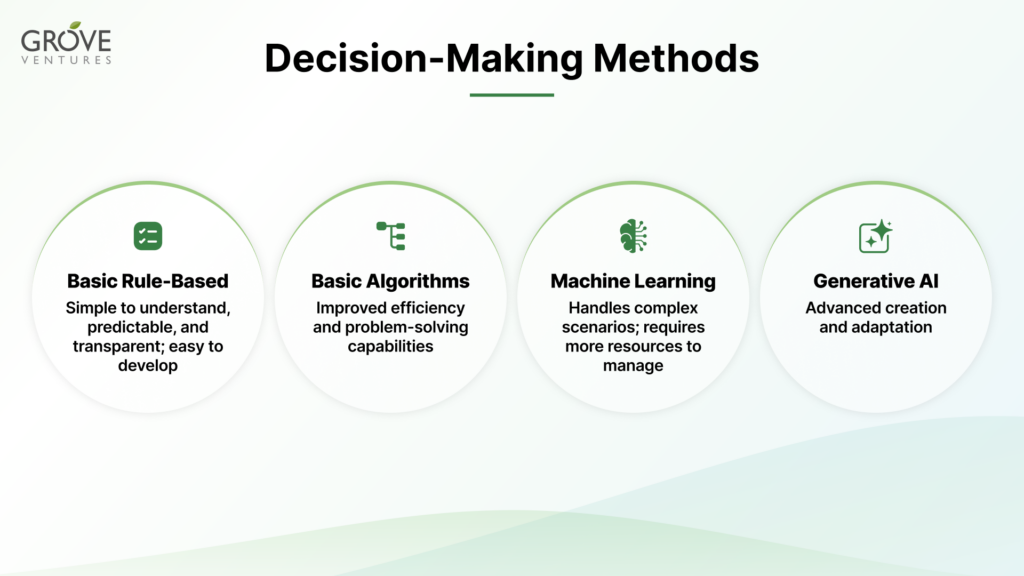
While in some cases Gen AI has been the enabling technology (like code generation, or content creation) – in many others, there was basic value even in previous generations. In some others, Gen AI does not offer improvements but only makes things more cumbersome and less predictable. Also, companies should adapt their chosen technology to their stage and needs; for example, if they don’t have enough data in the early days, an ML solution might not be a good fit.
In Navina’s case, it was very prominent that different problems called for different solutions. Navina uses a combination of home-grown, fine-tuned LLMs, and Gen AI capabilities for different functionalities within the product. For example, Navina’s proprietary, home-grown AI engine is top performing when it comes to primary care. When Navina compared performance to off-the-shelf models, Navina’s own outperformed for reading and interpreting primary care doctors’ notes and summaries and curating them into clinical insights, such as diagnosis recommendations. For other tasks, focused on text generation, such as clinical summaries after the patient visit, Navina was able to pair its own AI models with generative AI in order to automate the documentation.
Unlike the previous patterns which we’ve observed over time, this one emerged just in the past few months: LLMs are really transformational in how to approach workflows in AI-driven applications. Traditional software often relies on rigid, predefined workflows requiring extensive customization and maintenance. However, LLMs offer a more adaptable and intuitive approach to workflow management.
Key advantages of AI-driven workflows include:
These advantages enable features like automated task prioritization, dynamic form filling, and intelligent document processing – all of which can significantly streamline operations.
While sci-fi and modern culture have long feared the rise of robots, with each new layer of automation stoking visions of SkyNet, the real panic might be less about killer machines and more about the future of work.
Applications can sometimes act as decision-support systems that work with professionals in any field, assisting them with their work and suggesting actions, focus areas, and data to inform their decisions. With recent advancements in AI, we see more workflows becoming autonomous, making decisions and executing actions on their own. These workflows may replace complete areas that were previously dominated by professionals or even replace the professionals altogether. We have observed data-driven systems repeatedly succeed in empowering and enhancing knowledge workers’ performance. Think Gong.io for sales, or Zip for procurement as examples.
Our research has led us to favor implementations that keep a human in the loop. With most products, it takes time to reach the point at which users can trust AI to completely replace human decision-making. Building trust in AI systems and improving them takes time. Eventually, many companies will aim to develop autonomous agents, but we believe the right path involves starting with assisted systems. This approach ensures a gradual transition, where human expertise and oversight help refine AI capabilities, improve the data and the domain expertise, and foster trust and reliability in the technology.
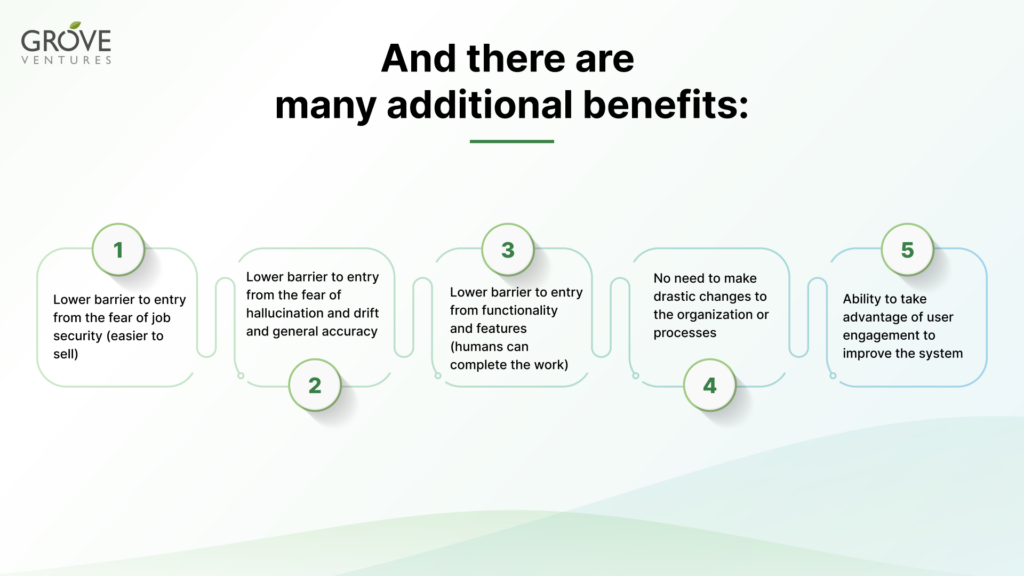
We have seen systems add more functionality as time goes by – and we believe that the approach of making step-by-step progress is a better way to build a full end-to-end (and potentially autonomous) system. When ActiveFence started, most of its offering involved harmful content flags that were sent to a content moderation enforcement or policy team, who would then make decisions based on that data. As ActiveFence scaled its capabilities and demonstrated them to their customers at large, more customers chose the automatic content moderation capabilities through an API, without a human in the loop, and the trust and value of the ActiveFence solution grew significantly.
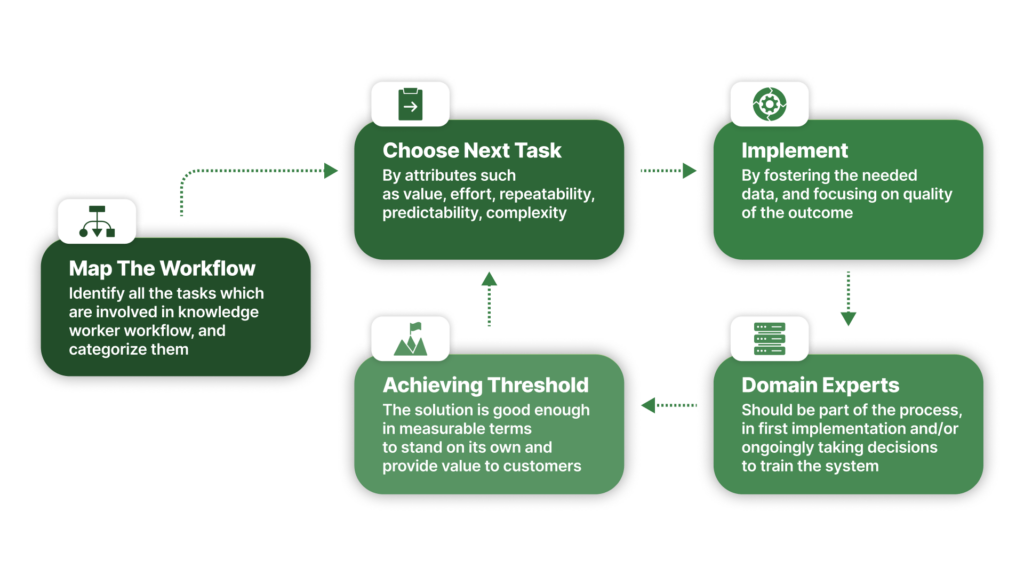
Step-by-step workflow automation begins with targeting predictable, repeatable tasks that professionals find time-consuming or boring. This initial focus quickly demonstrates value, boosting solution adoption and customer satisfaction. As confidence grows, we would recommend startups carefully expand to more complex areas, considering data needs, case variety, and personalization requirements. It’s advisable to start with decision-support rather than fully autonomous solutions, ensuring domain expertise is integrated throughout. For example, Muvan.AI, which operates in real estate, began by automating routine KPI report preparation, addressing a time-consuming task teams wanted to offload. This approach established a baseline value for their AI system while building the required trust for tackling more complex aspects of the workflow. By gradually increasing the scope and complexity of automation, companies can create differentiation and maximize the impact of their AI solutions.
In short, the ongoing process of product development towards full workflow automation will look something like this:
You know what the biggest problem with pushing all-things-AI is? Wrong direction.
— Joanna Maciejewska (@AuthorJMac) March 29, 2024
I want AI to do my laundry and dishes so that I can do art and writing, not for AI to do my art and writing so that I can do my laundry and dishes.
Many existing software platforms are successful descendants of an old ERP system that was developed decades ago – for example, a CRM by Salesforce, an EHR by Epic, QuickBooks by Intuit, and many others.
These systems succeeded by reinventing the data infrastructure and workflows that were tailored to specific business departments and processes. The most successful ones pushed their industries to grow according to the patterns and frameworks of the system. They primarily charged per seat and extracted more value by getting as many people as possible to be tenants on their platforms. These systems are in a conflict of interest with their customers and aren’t able to offer automation that might diminish their business.
New systems have the opportunity to charge based on the work accomplished, breaking the connection between seats and price. Their pricing is oriented toward the amount of assistance and business value these systems provide. We believe that this pricing approach is better for everyone, as it creates alignment of interests, striving to optimize work done for the customers (dubbed service to the customer).
Many of the companies we work with hire domain experts as an organic part of the team. This allows them to do better data cleaning and preprocessing: it helps them to tag data correctly before the product and the model actually work. It also allows them to better understand the workflows involved in the domain and identify the areas which are easier to automate, as well as validate that the developed solutions meet the expected outcome. While this was true before, we believe this is actually more relevant now than ever. As AI systems become more complex and less deterministic, there’s an increased need for ongoing governance and oversight. The unpredictability of AI systems makes continuous monitoring and management more essential.
In other words: it is rarely the case anymore that the product manager, engineering and QA define the software and make sure the outcome works as expected. When AI comes into play, the systems become a bit more complicated and less predictable. A domain expert as part of the team can help at all stages of the product life cycle. We highly recommend this approach in cases where the founding team is not an expert in the domain. Navina for example created a product that required medical expertise, which none of the founders had. Embedding a domain expert in their process, whether tagging data or conducting QA, led to a valuable solution.
No one knows how the business world will look on the other side of the Gen AI platform shift that we are experiencing. But we believe that at least some of the winners will be the companies that already start today by building data-driven learning systems, choosing an industry segment with smart integration into existing workflows, and empowering knowledge workers. We are excited to work with great founders who share their grand vision with us, and we are happy to share with them in return the lessons we’ve learned from partnering on such journeys.
Entrepreneurs and companies at the forefront of the Gen AI wave have a unique opportunity to redefine industry standards by building robust, data-driven learning systems. We encourage founders to invest in creating and curating proprietary data sets, integrating seamlessly into existing workflows, and empowering knowledge workers with decision-support systems. By focusing on these elements, companies will not only gain a competitive edge but also pave the way for transformative industry changes. We invite industry peers to share their experiences and insights, contributing to a collaborative effort in defining best practices for the future of AI-driven innovation.
As we look to the future, we at Grove Ventures are particularly excited about companies building verticalized AI systems. If you’re an entrepreneur ideating around that area, we’d love to hear from you!