A recent Calcalist article, features insights from Lior Handelsman, discussing how Google and Meta are trying to reduce the AI industry’s dependence on Nvidia – not only at the hardware level, but across the software stack that keeps developers locked in.
Why is Nvidia so hard to compete with?
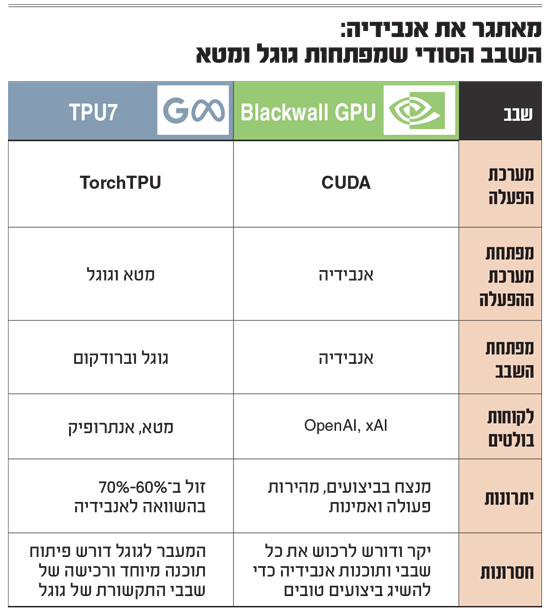
According to Handelsman, Nvidia’s dominance goes beyond chips. Its CUDA development environment became the industry standard, making it the default platform for building AI systems. That software lock-in made it difficult for rivals to gain adoption, even when alternative chips existed.
What changed with Google and Meta’s collaboration?
A key signal came when Meta agreed to purchase Google’s TPU chips – a rare move that pointed to growing interest in alternatives. Recent developments suggest the collaboration runs deeper, with both companies working to challenge Nvidia’s broader ecosystem.
Why is the real battle happening at the software level?
Handelsman points to PyTorch as a critical opening. Although it became closely associated with Nvidia, it was originally developed by Meta as an open-source framework. That gives Google and Meta a path to support AI development outside Nvidia’s stack, including through projects like TorchTPU.
What is driving the push for alternatives now?
The motivation is both strategic and economic. Nvidia’s solutions are highly effective, but companies do not want to remain dependent on a single supplier – especially in a market with trillion-dollar potential.
As Handelsman notes, the current situation, where everyone is locked into Nvidia, is creating strong motivation to build alternatives.
Read the full article here.