
Enzymit Achieves the World’s First Scaled Cell-Free Production of Hyaluronic Acid
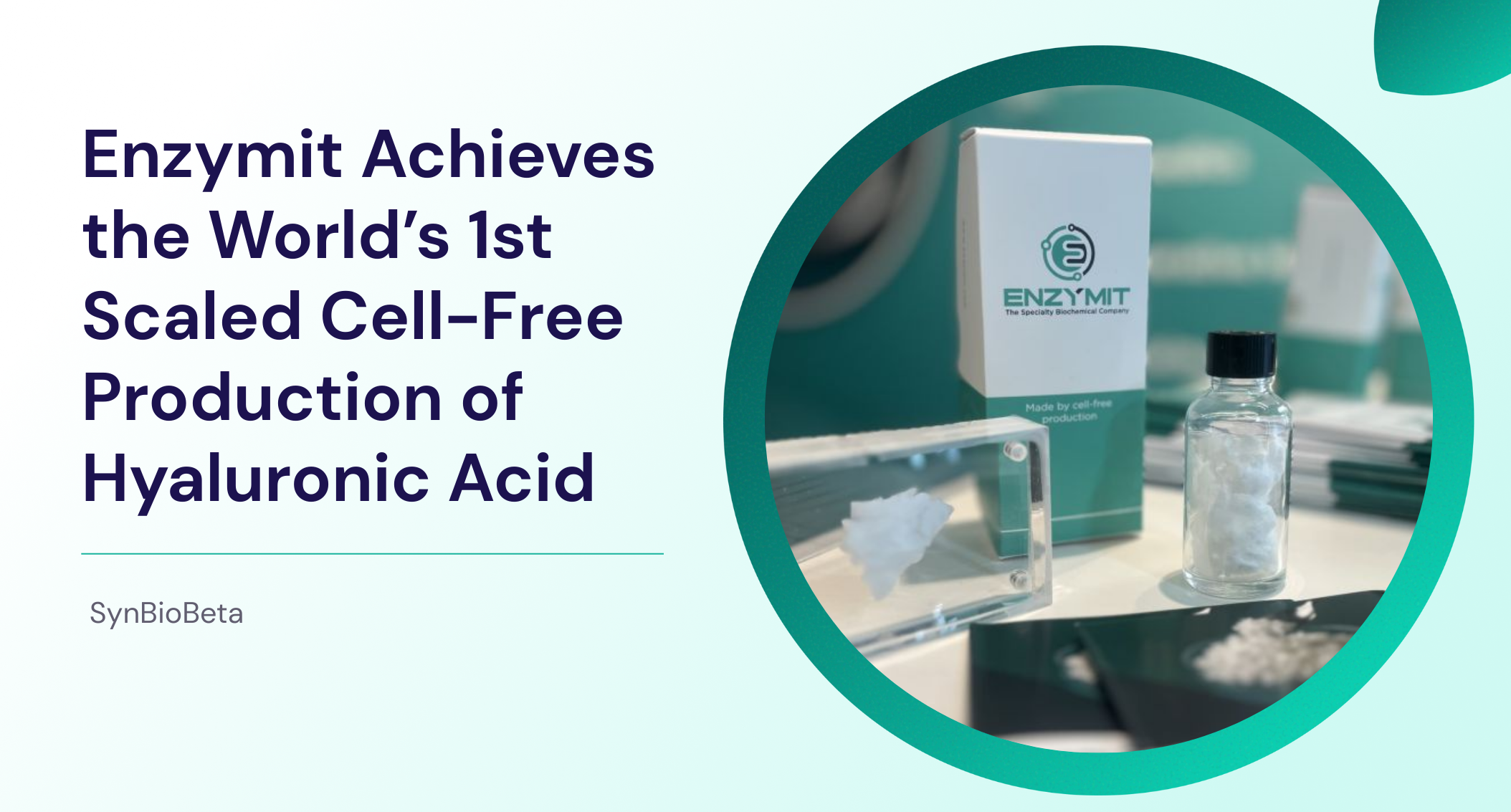
Congratulations to Enzymit for achieving a world-first milestone in synthetic biology and sustainable manufacturing.
In collaboration with Royal Cosun, Enzymit successfully produced multi-kilogram quantities of high-purity hyaluronic acid (HA) using a fully enzyme-only, cell-free biomanufacturing process. This pilot-scale production reached 200 liters and demonstrates a fundamentally new way to manufacture complex biomolecules, without relying on living cells.
This breakthrough not only improves efficiency, control, and consistency, but also allows manufacturers to precisely dictate polymer size, producing HA anywhere from 10 kDa to 4 MDa with a narrow size distribution. Unlike fermentation-based methods, this precision is achieved without modifying organisms or enzymes, significantly reducing biological variability and enabling more predictable, scalable production.
Hyaluronic acid is a critical biopolymer used in dermal fillers, wound healing, drug delivery, and tissue engineering. With a global market expected to grow from $9.43 billion in 2025 to $15.94 billion by 2035, demand for high-purity, high-performance HA continues to surge. Enzymit’s platform offers a faster, cleaner, and more flexible way to meet that demand.
This achievement highlights the power of AI-designed enzymes and advanced cell-free systems to reshape how the world makes molecules. By removing the inherent limits of cell-based manufacturing, Enzymit’s approach unlocks a new era of precision biomanufacturing, one where production is no longer constrained by biological bottlenecks.
As CEO Gideon Lapidoth said:
“This isn’t just a breakthrough in hyaluronic acid production—it’s a glimpse into the future of how we make molecules. By combining AI-designed enzymes with a robust cell-free system, we’ve removed biological constraints and proven that precision manufacturing is no longer limited by what cells can or can’t do.”
Enzymit’s partnership with Cosun demonstrates how quickly cell-free biomanufacturing can move from lab concept to industrial reality, paving the way for next-generation biomaterials that are scalable, sustainable, and highly customizable.
Read the full article here.